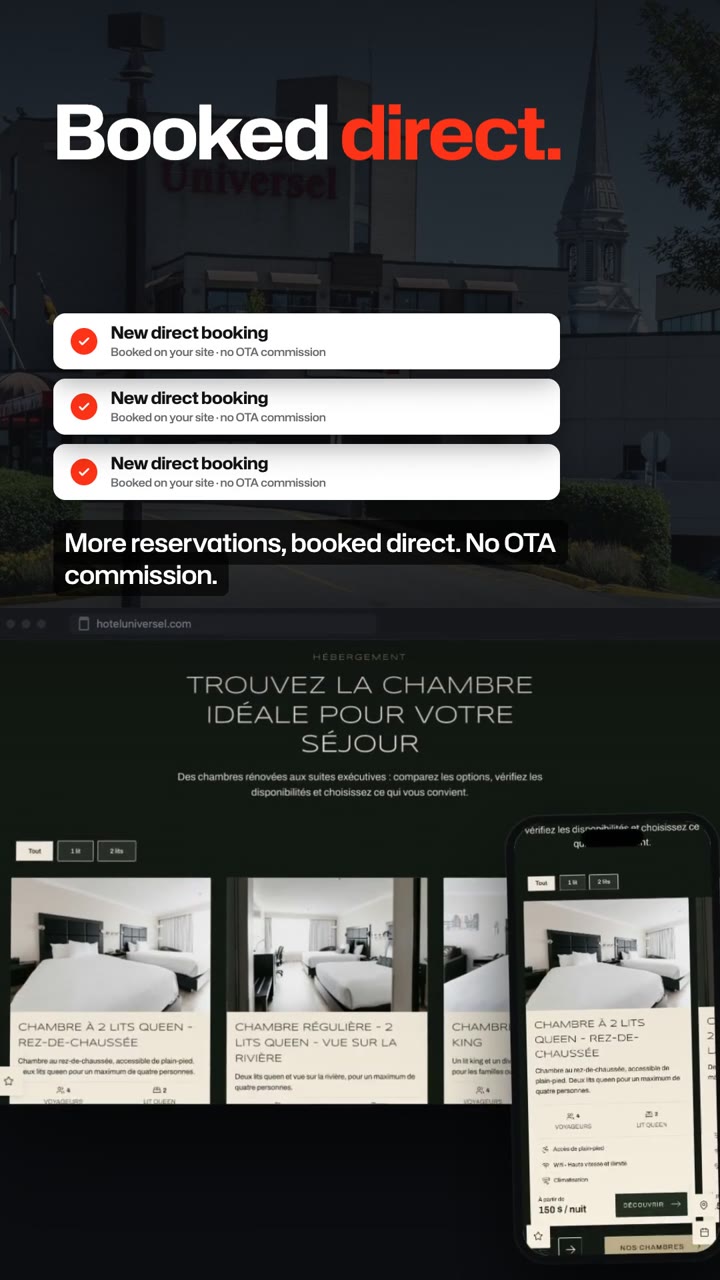
Every hotel owner I talk to knows what the OTAs charge. Fifteen, eighteen, sometimes twenty-five percent. They have the number memorized because it shows up on every statement.
The commission is the cost everyone sees. The second cost is the one that actually decides how independent your property will be in five years, and almost nobody puts it on a spreadsheet.
The first cost: the commission
This one is simple. A guest books a room on an OTA, the OTA keeps a cut. On a small hotel doing a few hundred thousand a year through those channels, that is a salary. Sometimes two.
I am not anti-OTA. They bring people who would never have found you. For a new property, or a slow season, they are a real distribution channel and pretending otherwise is naive.
The problem is not using them. The problem is depending on them.
The second cost: the guest
When someone books through an OTA, the OTA owns the relationship. They have the email, the booking history, the preferences, the review prompt. You have a name on a reservation and a guest who, next year, will open the same app and see your competitors right next to you.
So you pay the commission once to get the guest. Then you pay it again the next time that same guest comes back, because they come back through the platform, not through you.
That is the real math. A guest who returns three times over five years, all through the OTA, cost you three commissions for one relationship you never owned.
What a direct booking strategy actually is
Most people think direct bookings means having a booking button on the website. That is the last step, not the strategy.
A direct booking strategy is everything that makes a guest choose your site over the platform:
A website that converts. Fast on a phone, real photos, the booking engine one tap away from every page, prices that match what the OTAs show. If your own site is slower and more confusing than the platform, guests go back to the platform. They are not wrong to.
Being found. Ranking for the searches that matter in your area, and being the source that AI assistants quote when someone asks where to stay. If nobody finds your site, it does not matter how good it is.
A reason to book direct. Something the platform cannot offer. A better cancellation policy, a small perk, a room you only sell direct. Guests are not loyal to you yet. Give them a reason.
Keeping the guest after the stay. Their email, a short follow-up, a returning-guest offer. This is where the second cost gets recovered. Every guest you keep is a commission you never pay again.
Measure one thing
I tell every client the same thing: track direct bookings, month over month. Not traffic, not likes, not impressions. Direct bookings.
Traffic that does not turn into reservations is a vanity number. A website that looks beautiful and books nothing is an expensive brochure. The only score that matters is how many guests booked with you instead of through someone else, and whether that number goes up.
Where to start
Open your own website on your phone and try to book a room. Time it. Count the taps. Compare the price to what the OTA shows for the same night.
If it takes longer, costs more or feels less trustworthy than the platform, you already know where your next guest is going to book. Fix that first. Everything else in the strategy builds on top of it.